“We salute all peoples who are fighting/We honor all those who have died/For the cause of freedom.”
Manno Charlemagne, “Ti Manno,” was a popular Haitian musician whose songs, drawn from Haiti’s acoustic rural musical traditions, rallied the poor and unheard masses against the ravages of U.S. imperialism and its local comprador class. Born in one of the impoverished popular neighborhoods in Haiti’s capital, Port-au-Prince, Charlemagne understood the struggles of the people. Growing up during the brutal Duvalier dictatorship, his music challenged not only the violence of the dictatorship, but also its protection by U.S. imperialism. He was tortured and exiled by Duvalier, but continued to produce his political songs abroad.
After the fall of Duvalier in 1986, Charlemagne rode the wave of support for Jean Bertrand Aristide, who became Haiti’s first democratically-elected president in 1990. When Aristide was deposed nine months into his presidency in a CIA-backed coup d’etat, Charlemagne, like many Aristide supporters, was brutalized by the military. Unlike many, he was able to slip out of the country into exile. Charlemagne returned to Haiti in 1994 when Aristide was brought back by Bill Clinton, with the country's occupation by thousands of U.S. Marines. From 1995 - 1999, Charlemagne served as the Mayor of Port-Au-Prince.
Working within Haitian government structures, Charlemagne became even more disparaging of U. S. imperialism, especially its use of western-controlled institutions masquerading as “international” organizations. Indeed, in 1986 he had written the song “Oganizasyon Mondyal/International Organizations,” which was a critique of US imperialism, especially under the cover of international “aid” to Haiti. In the song, Charlemagne said that international organizations are set up “to help the thieves plunder and devour.” He saw them as worthless, set up to maintain the global hegemony of the west, and to support a particular class – intellectuals, especially – who always “call for intervention against the people who are rising” when “their interests are threatened.”
Significantly, what influenced the writing of the “Oganizasyon Mondyal/International Organizations,” occurred far away from Haiti – even though it mattered to Haiti. In an interview, Charlemagne revealed that he had written the song in the aftermath of the zionist-backed 1982 massacre of Palestinians at the Sabra and Shatila refugee camps in southern Lebanon. In the interview, Charlemagne reserved a particular contempt for the United Nations. Charlemagne said: “I saw [United Nations Secretary General] Javier Peres de Cuellar think [that] by drinking a glass of wine with King Hussein of Jordan, he can resolve that problem.” He was referring to the so-called “peace process” (the secret Oslo Accords) underway that would consolidate zionist control of Palestinian land and people.
But the tone of Charlemagne's “Oganizasyon Mondyal/International Organizations,” was not defeat; it was resistance. In the final stanza of the song, Charlemagne salutes the brave wretched of the earth who fight and die “for the cause of freedom.” And it concludes with a contemptuous invocation of those western “aid” pimps, who make a living off the people’s misery: “we spit in your face.”
For freedom fighters everywhere, we reprint Ti Manno’s “Oganizasyon Mondyal” below.
International Organizations
Manno Charlemagne
The international organizations are not for us;
They're there to help the thieves plunder and devour.
When people who are suffering arm themselves,
Know that they are exhausted.
International medicine stays on the sidelines.
They hold meetings, they sit and they bullshit
With a glass of champagne, a nice imported wine
And that's it.
When people are under the gun all over the world,
Don't give me all that analysis
When you really don't give a damn.
What people don't want to hear
Is the truth.
Underdeveloped reactionaries are the most dangerous of all —
When their interests are threatened, they're always the ones
Who call for intervention against the people who are rising
The dominant class is very clever:
In principle they know they are the minority,
They know how to play it,
Their class position is what counts.
They'll do the impossible, they'll rampage
To eliminate the child in the womb.
We will fight until the corn is ripe, until we are free.
We take heart from the struggles of other peoples who are not afraid to die.
Their deliverance is their efforts, is in their blood that is shed.
As for the pills the doctors would like to prescribe,
They throw them away.
We salute all peoples who are fighting,
We honor all those who have died
For the cause of freedom.
As for those Haitian dogs who say they are cultured
While making a living at their universities
From the suffering of refugees,
We spit in your face.
--------------------------------
Oganizasyon Mondyal
Manno Charlemagne
Oganizasyon mondyal yo pa pou nou yo ye
Sa la pou ede volé yo piye, devore
Lè pep ki nan di pran fizi yo
Konnen yo bouke
Lamedsin entènasyonal sa met kò l sou kote
Yo fè reyinyon, yo pale, yo ranse
Devan vè chanpay, bon diven k enpote
Se la sa rete
Lè pep anba zam tout peyi, tout kote
Mwen renmen tande zot k ap analize
Lè l pa konsène
Lè l pa konsène
Tout sa yon moun pa vle tande
Se vérité li ye
Reyaksonè sou devlope yo sa pi danjere
Lè entere yo menase, se yo k toujou rele
Tout fos entèvansyonis yo pou pep ki soulve
Laklas dominan entelijan ke li ye
An prensip konnen ke l an minorité
Li konn kijan pou l jwè
Pozisyon de klas li se sa ki konte
La fè lenposib, l a kraze, l a brize
Pou l éliminé ti moun ki nan ze
Ν ap goumen jouk mayi mi, jouk tan nou libere
Pran konfyans nan lit lot pèp yo ki pa pè tonbe
Delivrans yo se jefo yo lan san ki ap koule
Grenn doktè ta vle preskri
Yo voye sa jete
Ν ap voye yon sali pou tout pèp k ap lite
Anpil konpliman pou tout moun ki tonbe
Pou koz libète
Pou chen Ayisyen k ap di yo kiltive
Κ ape fè komès ak mizè refijye
Lan inivèsite, nou voye yon plot krache
The lyrics for Manno Charlemagne’s ”International Organizations/Oganizasyon Mondyal” were translated and printed in a fall 1996 special issue of the journal Conjunctions titled, the archipelago: NeW CaRiBBeaN WRiTiNG (1996).





 In this week’s segment, we have an update on the US/Israeli war of aggression against Iran from a journalist reporting from Iran. But we begin with two organizers of the Pan-Africanism Summit Against…
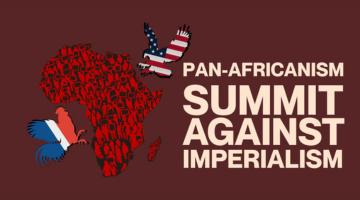 The Pan-Africanism Summit Against Imperialism (PASAI) will be held on May 11 and May 12 in Nairobi, Kenya. It is organized as a counter-summit to the France-Africa summit taking place in Nairobi at…
 Navid Zarrinnal is an Iranian journalist and host of The Colony Archive podcast. He joins us again from Iran to discuss the fragile "cease fire," Trump's threats, the Strait of Hormuz, and how Iran's…
 Beliefs in white supremacy and manifest destiny are at the heart of Donald Trump’s actions and his appeal to millions of people.