Guyanese President Irfaan Ali, left, with Secretary of State Marco Rubio on Thursday in Georgetown, Guyana.
U.S. Secretary of State Marco Rubio’s recent tour of Jamaica, Guyana, and Suriname was framed as advancing 'energy security' and regional stability. However, it served as a cover to escalate pressure on Venezuela. The trip exposed Washington’s broader agenda: dismantling regional solidarity and replacing it with U.S.-controlled energy dominance.
Originally published in Internationalist 360.
On March 24, the State Department announced Marco Rubio’s visit to Jamaica, Guyana and Suriname on March 26 and 27, with the justification of “advancing President Trump’s U.S. foreign policy priorities in the Caribbean”.
However, the selection of these destinations and the current context, marked by the threat of imposing secondary tariffs on Venezuela and the interest in what they call “energy security”, show that the real focus of the tour is on this country.
This was made even clearer on March 25 when Department spokeswoman Tammy Bruce stated that the U.S. administration seeks to “strengthen energy security” and “oppose malign influences that threaten the stability of our hemisphere,” a euphemism that, in Washington’s geopolitical language, points directly to Venezuela.
But it was the Special Envoy for Latin America, Mauricio Claver-Carone, who laid bare the true agenda of the tour by referring to the Caribbean as “our third border and, in some cases, our first border”. He linked the itinerary to a strategy of control over maritime routes and energy resources in the region, traditionally linked to Venezuela’s cooperation.
His most revealing statement was: “All that is over and the time has come to turn the page”, he said, alluding to Petrocaribe and the campaign to try to substitute Venezuelan crude oil barrels and derivatives in the basin.
The insistence on the “historic opportunity for energy security in the Caribbean” is not accidental: under the pretext of combating alleged “extortive practices”, the real objective is to displace the participation of Caracas and reconfigure the regional energy map in favor of Washington’s interests.
This tour is not an isolated event but part of the systematic framework of the obsessive agenda of pressure against Venezuela developed by the Secretary of State.
RUBIO’S PAWN
For years, the current head of U.S. foreign affairs has been making progress in converting Guyana into a bridge of attack against Venezuela.
With a weak state and a submissive political elite, the Cooperative Republic has become an easy target for actors like Rubio, who see in the territorial dispute with the neighboring country a strategic platform to advance the geopolitical objectives of the U.S. empire.
His relationship with the Guyanese government is not new. During the 2020 elections in that country, the then senator actively lobbied David Granger, promoting the “transparency” of the electoral process, to ensure the victory of Irfaan Ali, who won by a minimal margin.
Once in power, the now Guyanese president and his administration have spared no gestures of alignment with U.S. foreign policy, especially when it comes to Venezuela.
In September 2024, Rubio held a meeting with the president in which he made clear the closeness of their positions. As soon as his nomination as Secretary of State was confirmed in January of this year, his first call with Ali already hinted at the direction of his policy in the continent, focused exclusively on Venezuela: the White House would “firmly support the territorial integrity of Guyana” in the face of what he described as “bellicose actions of Nicolás Maduro and his henchmen”.
Guyanese officials openly welcomed his appointment. “We are extremely pleased to have Senator Rubio as Secretary of State. We look forward to strong solidarity from him and President Trump, as well as the U.S. administration, on the Guyana-Venezuela border dispute,” Vice President Bharrat Jagdeo affirmed on November 14, 2024.
It is also worth recalling that in an opinion piece for the “Orwell Report” portal in January 2024, Rubio stated that “if we are to maintain U.S. strength throughout the 21st century, we need allies like Guyana to be free, dictators like Maduro to be deterred and the entire supply chain, from the mine to the assembly line, to be secure”.
In exchange for U.S. backing, the Guyanese administration has been willing to offer even what it does not have. Therefore, that territory has become a useful pawn in the chessboard of the now Secretary of State to attack Venezuela by any possible means.
STATEMENTS IN GUYANA
Rubio participated in the summit of the Caribbean Community (Caricom) in Kingston, where he met with the high authorities of Haiti, Jamaica, Barbados and Trinidad and Tobago. Subsequently, on March 27, he arrived in Georgetown on a visit that coincided with joint military exercises between the U.S. Navy and the Guyanese Defense Force.
During his stay, a memorandum of understanding was signed to strengthen collaboration in security, with emphasis on the exchange of information, the fight against organized crime and military cooperation, actions which seek to increase the presence of the United States in the region and to exercise provocations towards Venezuela, ignoring its legitimate claim over the Essequibo.
In the press conference with Irfaan Ali, nicknamed “Zelenski of the Caribbean”, Rubio insisted on the “threat” that Venezuela represents for the region and left open the possibility of US retaliation in case of a territorial conflict.
The President’s tone was obviously aligned with Washington’s interests, so he thanked for the support offered by that country in security matters and affirmed that the meeting served to “define policies and consolidate a bilateral agenda” in key sectors such as energy, infrastructure and defense.
In addition, he did not miss the opportunity to falsely accuse Venezuela of “flagrant violation” of the order of the International Court of Justice and the Argyle Declaration.
It is worth mentioning that on March 13, within the framework of the CERAWeek forum, Ali met in Houston with General Randall Reed, head of the United States Transportation Command (Ustranscom), which reinforced the colonial subordination in military terms before Washington in a context of growing tension in the Essequibo.
Now, the Cuban-American, faithful to his aggressive discourse, described Venezuela without evidence as a “drug-trafficking regime” with “illegitimate territorial claims” and warned that any action by Caracas against Guyana or ExxonMobil would have “serious consequences”.
His statement is not coincidental: the oil corporation is crucial in the illegal exploitation of the oilfields in the Atlantic coast of the Venezuelan Essequibo, so the interest of Rubio’s visit was also focused on offering greater security guarantees to the company’s illegal activity.
In addition, ExxonMobil’s presence in these areas not only pursues economic interests but also forms part of a strategy of geopolitical domination. The Secretary made this clear when he stated that the United States seeks to “be a partner” in the “transformation” of the country, a phrase that masks its direct interference in energy and military matters.
The signed agreement consolidates this dynamic and transforms the former British colony into a territory under Washington’s effective control, that is, its satellite, under a pattern of colonization by economic, military and energy means.
He went on to add more comments in his longed-for plan of military escalation against Venezuela: “It would be a very bad day for the Venezuelan regime if they attacked Guyana, a very bad week, and it would not end well for them”, he openly threatened.
Rubio left no room for ambiguity in his statements. “I’m not going to go into details about what we would do, but I think everybody understands,” he said, in a veiled warning that suggests the United States already has an apparent plan for military action in the event of an escalation in the Venezuela-Guyana territorial dispute.
THE OBVIOUS PRETEXT: ARAGUA TRAIN
Predictably, the former Republican senator repeated the worn-out script about criminalizing Venezuela as a justification for pushing the goal of a greater military presence in the region.
In the conference with reporters he introduced this point: “And by the way, we also want to get rid of gang members.
Venezuela has sent us a number of them. I’m sure you have heard of the ‘Tren de Aragua’, a terrible gang, a vicious gang”.
As we have documented in Misión Verdad, the narrative about the Aragua Train, especially after the false flag operation on the Cuyuní River, was useful in constructing the image of a supposed transnational threat.
Through a meticulously orchestrated media and psychological operation, an attempt is made to capture the attention of the U.S. administration and position the conflict as a priority “regional security” issue.
This resource allows Washington, in particular the former Cuban-American senator, to justify not only illegal sanctions and diplomatic pressure but also further interference in the Essequibo.
In this context, the signing of the memorandum with the information sharing clause opens the floodgates for future false flag operations in which the Guyanese government, with the collaboration of the United States, can arrest any Venezuelan and accuse him without evidence of belonging to the Aragua Train.
Rubio said: “So I think if we have information that someone has entered your country [Guyana] with bad intentions, we want to be able to share it with your government. We have information about a member of the Tren de Aragua gang from Venezuela. We want to make sure we have collaboration and share news. If we have information that some drug traffickers are establishing themselves here and have decided to turn this into a base of operations, which could generate violence and war, like gang warfare, we want to share it with you.”
This would contribute to the construction of the dossier that the Secretary of State is expediting with the objective of capturing Trump’s attention on the situation in Guyana and linking this scenario with the defunct gang in Venezuela, which has been a central axis in the new pressure agenda against the country. Consequently, the Guyanese colonial enclave will continue to present Venezuelan migrants as a “threat” in order to justify future coercive and repressive measures, both in the United States and in the region.
This is not a new script, the strategy follows the same pattern that the White House has applied in other scenarios: overstating security problems to justify interventions and execute geopolitical objectives.
The securitization of discourse is a recurring tool to transform strategic disputes into supposed crusades against crime, paving the way for more aggressive actions.
Indeed, Rubio fuels the discourse with unconscionable claims by describing the migrants detained in El Salvador as “really bad people” and taking the comparison to the extreme by equating them with the most dangerous prisoners at Guantanamo: “The Marines at Guantanamo said these are some of the toughest people we’ve ever interacted with. They were worse than the Al Qaeda members who were in their jails. Think about that.”
Such statements, uttered with alarming flippancy, not only exaggerate the situation but also seek to generate an alarming state of affairs that would justify more aggressive measures.
The recent “security” agreement between the United States and Guyana is part of a calculated maneuver to entrench Washington’s interference in the region and consolidate Georgetown as an outpost in its geopolitical strategy against Venezuela.
The Cuban-American secretary, with his incessant fixation on Venezuela, has found in the Essequibo an opportune front to feed his destabilizing plan.
The growing colonial domination over Guyana, the investments in security infrastructure and the insistent discourse on a supposed “Venezuelan threat” respond to an ostensible design that seeks to justify a greater U.S. presence in the area and, at the same time, guarantee ExxonMobil’s interests in the waters to be delimited.
Finally, as Claver-Carone said in the recent press conference on this trip, “the Achilles heel in the Caribbean has been Petrocaribe”, an admission disguised as a threat that confirms what Washington has been trying to hide for years: the energy cooperation promoted by Venezuela has been and will continue to be a retaining wall against the hegemonic plans of the United States in the region.
Washington’s interference agenda persists, ExxonMobil stands as the corporate arm of this strategy ensuring that the territorial dispute and diplomatic pressures serve its interests, but in conjunction with every desperate maneuver to rewrite the regional energy map -of what is considered the US “third frontier”- the only thing they evidence is their interest in tearing down the energy cooperation platform built by Caracas in the region.

 In this week’s segment, we have an update on the US/Israeli war of aggression against Iran from a journalist reporting from Iran. But we begin with two organizers of the Pan-Africanism Summit Against…
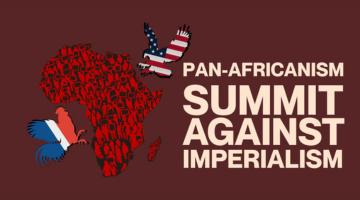 The Pan-Africanism Summit Against Imperialism (PASAI) will be held on May 11 and May 12 in Nairobi, Kenya. It is organized as a counter-summit to the France-Africa summit taking place in Nairobi at…
 Navid Zarrinnal is an Iranian journalist and host of The Colony Archive podcast. He joins us again from Iran to discuss the fragile "cease fire," Trump's threats, the Strait of Hormuz, and how Iran's…
 Beliefs in white supremacy and manifest destiny are at the heart of Donald Trump’s actions and his appeal to millions of people.
 “The ever-scheming European imperialists wisely placed Israel where she could geographically divide the Arab world…and also divide the Africans against the Asians.”