Misogynoir, a term meant to name the specific violence against poor and working-class Black women is now being used as a shield for political elites.
Originally published in Scalawag Magazine.
Introduction
Identity reductionism—often misidentified as and used interchangeably with identity politics, coined by the Combahee River Collective—has become one of the definitive political reflexes of our time: an automated response that prioritizes symbolic protection over substantive engagement. In my own imperfect words, it is the liberal tendency to parasitically latch onto people who are categorically oppressed by systems: white supremacy, racial capitalism, cisheteropatriarchy, ableism, and/or saneism, to name a few. Yet, they are ideologically in conflict with the social justice movements that seek to dismantle that oppression. Instead, they embrace rival projects, like assimilation, mere tolerance, and begrudging coexistence. This alignment stems, I believe, from either a fundamental naivety or a sincere conviction, one I have yet to fully comprehend, that these alternatives are superior, and they usually are, for those individuals alone.
Nowhere is this tendency more evident than in the swift, brutal shutdown of any principled political criticism directed at the anointed few Black women politicians within the American liberal establishment. This year, Congresswoman Jasmine Crockett cemented her place among these women.
Critiques of Crockett from those firmly on the Left are straightforward and rooted in our current moment of profound global sociopolitical crisis: her documented complicity in the U.S.-Israeli genocide in Palestine; her failure to meet the political moment's demand to abolish ICE; and the strategic question of whether her well-funded national profile warrants continued financial support from ordinary Texans—a profile built, in part, on the escalation of body fascism, recalling her "bad built, butch body" remark and 2024 merchandise collection, that, as a Black fat queer, never sat right with me.
These critiques are not met with principled counter-argument, not even with the hollow retort that "voting is harm mitigation" or the liberal reframing of white supremacy as a mere character flaw, as we've heard time and time again. Instead, they are met with the thermonuclear charge of misogynoir, leveled by Black and non-Black liberals alike.
Misogynoir, a term coined by Moya Bailey, describes the specific, systemic antiBlack racist misogyny that Black women face. It is built upon the Black feminist tradition of naming the dangerous intersection—specifically for poor and working-class Black women—as both a site of unique oppression and, in the tradition of the likes of the Combahee River Collective, June Jordan, Assata Shakur, and Claudia Jones, a potential site of radicalization. Yet, its reflexive deployment in this context reveals less about the substance of the critiques and more about a disturbing political pathology: the elite capture of radical language by a liberal establishment engaged in a form of Negrophilia, a fetishistic, self-serving adoration of Black symbols that masks a fundamental opposition to Black material liberation, whether intended or unintended.
This pathology operates on a dual axis that prevents meaningful discourse about the material conditions we as Black people face, all while obscuring the diversity of the elite class that perpetuates it. First, it weaponizes a term forged in Black feminist struggle as a personal, inviolable shield for political elites, thereby hollowing it of its revolutionary intent. Second, it exposes a sentimental allegiance rooted in a psychological need of the ruling class and those aspiring to join it.
They cling to symbolic avatars as a salve for their own political impotence and complicity, creating a perverse dynamic where defending an individual substitutes for pursuing justice for a collective.
The Farce of "Blackity-Blackness"
As it relates to the defense of figures like Congresswoman Crockett, the critique is often dismissed as a mere dislike of her style, a rejection of an "unapologetically Black" or "Blackity-Black American" woman. But this is a profound misdirection. We are told to look at her record—a retort that makes me cringe in light of the deepening literacy crisis in our state, let alone the trained literacy required to parse the legislation to which she refers. It evades the fundamental question: Is your vision aligned with our values, and do your plans directly meet the material needs of Texans?
When the response to basic accountability is "look at my record"—from her stance on Israel to her stance on ICE—or a retreat into the spectacle of sparring with Trump, it confesses a lack of genuine political imagination. The transaction is framed backwards: We do not owe a politician our support for simply being a qualified Black woman in the arena.
For one, the arena should be full of so-called qualified people. When any one of us sits on a plane, surely, we assume that it will land? More critically, we must interrogate what it means to be "qualified" to hold power in a state whose identity was forged through such violence.
This qualification is not abstract. Right now, many are resistant to grappling with the fact that ICE funding soared under the Obama-Biden Administration, with the ICE agent who murdered Renée Good joining the government agency in 2016—the final year of that administration—after a military deployment in Iraq. In her debate against Representative James Talarico, Crockett pledged not to end the terror her party has financed, intensified, and enabled, but to "clean house" of the "Proud Boys" within ICE. As ICE escalates, even Texas Governor Greg Abbott has called for the agency to "recalibrate." With Texas leading in ICE-facilitated arrests, DHS pursuing plans to open a new ICE detention facility in Dallas County, and public outcry over the murder of Geraldo Lunas Campos while in ICE detention in El Paso, it should terrify every person of conscience that neither dominant political party vying for power in our state intends to stand in the way of ICE's expansion.
The obligation of any candidate is to prove, consistently and courageously, that their governance models the world we deserve. When the "realness" of a political brand is deployed against a boorish opponent like the Trump-Vance Administration but goes silent before the bare machinery of empire—when people are being shot in the head by ICE and mutilated by bombs paid for with our taxes in Palestine, Venezuela, Iran, and elsewhere—then the performance isn't realness. It is complicity with a prettier, browner face. This failure to rise to the historical occasion, to choose the spectacle of partisan combat over the substance of confronting genocide, will not be forgotten. It earns its own epithets: not "Auntie" or "Queen," but, if the 2024 federal elections taught us anything, likely Genocide Jasmine, Killer Crockett.
This is the signature move of elite capture: co-opting a framework designed to protect the vulnerable to instead immunize the powerful. The charge of misogynoir, in this corrupted form, becomes a discourse-ending cudgel. It creates a zone of impunity where accountability, on issues from ICE to the genocide in Palestine, is deemed intrinsically oppressive. The central question inverts from "What kind of accomplice or opponent will this politician be in our fight for liberation?" to "How dare you question whether a Black woman can lead?"
The Psychology of Elite Capture
But to understand the ferocity of this defense, we must look beyond strategy and into psychological need. Figures like Congresswoman Crockett, Vice President Kamala Harris, and Representative Stacey Abrams are not followed for a consistent, radical praxis. In fact, their records are often marked by profound compromise. They are adored for their performance of defiance. The viral clap-back, the stirring speech laden with symbolic weight, the historic "first"—these are the currencies of this exchange.
For a predominantly white and white-aspiring professional-managerial class, committed to the fiction of a redeemable system yet gripped by powerlessness, these women become avatars of absolution. Their perceived strength becomes a proxy for the follower's lack of agency; their presence at the table is mistakenly celebrated as the dismantling of the table itself.
This is liberal Negrophilia in its purest form: a love that consumes the symbol and abandons the people. It requires the Black woman in question to remain a flawless, fighting icon, and never a complex, fallible, negotiable political subject.
The careers of Harris and Abrams lay this bare. At the height of the BLM movement, Harris's 2020 and 2024 presidential campaigns faltered under the weight of her "top cop" record, a legitimate, necessary critique. Yet that engagement was universally reframed as a uniquely vicious, identity-based attack. Her symbolic identity remains a force field, deflecting criticism even as her role as VP globalized her top cop persona, informing her policy decisions regarding "border security," and her unflinching advocacy for Israel's genocide, which has rightly earned her the moniker "Holocaust Harris."
This is not name-calling; it is historical accounting.
Similarly, Abrams's vital work on voting rights in Georgia was transformed into a mythological narrative of saintly resistance, funneling money and monochromatic attention to a centralized brand. This often came at the expense of the broader, Black-led grassroots ecosystems doing the same and deeper work without advocating for increased police pay in the years immediately following the national uprising to protest the murder of George Floyd. To question the strategy was to commit political sacrilege, exposing the quasi-religious fervor, not political analysis, underlying the support.
Shattering the Shield
The consequences of this tendency are corrosive in more ways than one. First, it strips our most precise language of meaning. When misogynoir is applied indiscriminately, it loses the power in its precision and becomes background noise—a cynical ploy that ultimately harms the very people it acts as language to.
Second, and more devastatingly, it prioritizes sentiment over substance. A politics driven by the emotional needs of the neoliberal elite will never meet our material demands, especially if they are revolutionary. The digital army that mobilizes to defend a politician from any and all critique rarely mobilizes with equivalent ferocity for policies to address the compounding crises facing us all, from housing and healthcare to the expansion of the prison-industrial complex. The loyalty is to the avatar's image, not to the outcome of liberation.
Ultimately, this convergence of elite capture and Negrophilia represents a profound failure of solidarity. Solidarity is not a feeling; it is a practice rooted in shared commitment and mutual accountability. It requires the hard, uncomfortable work of critique and holding those who claim to represent us to the highest standard. What passes for solidarity in the liberal sphere is too often feel-good, political cosplay, where defending a symbol substitutes for struggling against a violent system, toward its full abolition.
Breaking this cycle requires a deliberate rejection of these comforting fictions. It means reclaiming our analytical tools from the elite who wield them as weapons of conformity. It means demanding that symbols, no matter how resonant, be subjected to rigorous scrutiny. And it means understanding that true allegiance to Black women is measured not by the ferocity with which one defends a chosen individual on social media, but by the relentless pursuit of a world where all Black women are free from all forms of white supremacist patriarchal violence and capitalist exploitation.
That pursuit requires holding everyone accountable, especially those who wear our likeness and speak in our name. The shield, once a tool for collective defense, has been turned into a cage for critical thought. It must be shattered. The fetish is not a protection; it is a prison of its own making, and it is leaving our people, here and abroad, in ruins.
Sol Elias is a Black Muslim feminist lawyer, writer and full-spectrum birth worker based in the Greater Atlanta Metro area. Sol’s legal and policy background is primarily in eliminating patriarchal violence, family policing abolition, international human rights, and bodily autonomy.




 In this week’s segment, we have an update on the US/Israeli war of aggression against Iran, from a journalist reporting from Iran. But we begin with a discussion with two organizers of the Pan-…
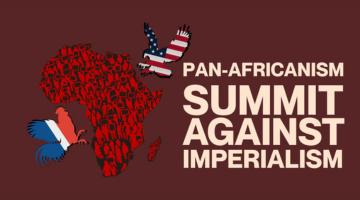 The Pan-Africanism Summit Against Imperialism (PASAI) will be held on May 11 and May 12 in Nairobi, Kenya. It is organized as a counter-summit to the France-Africa summit taking place in Nairobi at…
 Navid Zarrinnal is an Iranian journalist and host of The Colony Archive podcast. He joins us again from Iran to discuss the fragile "cease fire," Trump's threats, the Strait of Hormuz, and how Iran's…
 Beliefs in white supremacy and manifest destiny are at the heart of Donald Trump’s actions and his appeal to millions of people.
 “The ever-scheming European imperialists wisely placed Israel where she could geographically divide the Arab world…and also divide the Africans against the Asians.”