Acting Attorney General and Minister of Energy Stuart Young and Minister of National Security Fitzgerald Hinds hold a press conference at the National Security Ministry in Port of Spain, Trinidad and Tobago, on December 30, 2024. (Photo: Yahoo News)
Trinidad is experiencing an unprecedented crime wave. The state has responded by militarizing the police and loosening restrictions on their actions. To understand these mechanisms, one must look at Trinidad's relationship with the United States.
Trinidad and Tobago has recently declared a state of emergency in response to an alarming surge in violent crime, culminating in a murder toll of 623 for 2024—the highest recorded in the nation’s history. This decision grants police the authority to conduct warrantless searches and detain suspects for up to 48 hours, reflecting the government's desperation to address escalating gang-related violence and narcotics trafficking. However, this domestic crisis cannot be understood in isolation; it is deeply entangled with the country’s economic woes, neoliberal policies, and an expanding militarized presence shaped by its partnership with the United States Southern Command (SOUTHCOM).
Neoliberalism: A Catalyst For Crime
The crime wave in Trinidad and Tobago is a symptom of deep-seated structural inequalities rather than a mere law enforcement issue. High unemployment, inadequate public services, and systemic corruption have eroded public trust, leaving many feeling abandoned by the state. Neoliberal policies, which prioritize market efficiency over social welfare, exacerbate these challenges by dismantling public institutions and concentrating wealth in the hands of a few. Emphasizing privatization, deregulation, and reduced government spending, these policies have widened income inequality and weakened social safety nets. Higher utility rates, the sale of state assets to foreign multinationals, and regressive taxation disproportionately burden the working class. This growing inequality is starkly visible in the education and healthcare systems, where access is often determined by socio-economic status, fostering social unrest and driving crime, as economic despair pushes individuals toward desperate means of survival. Similarly, insufficient governance and failing state institutions further marginalize the most vulnerable, perpetuating cycles of poverty and crime. The government’s reliance on punitive measures, such as the state of emergency, does little to address these root causes, instead criminalizing the very communities most affected by systemic neglect.
Trinidad and Tobago’s economic structure has long been tethered to its energy sector, which accounts for over 36% of GDP (2022). Despite this wealth in natural resources, the nation’s dual economy—split between the energy sector and services such as distribution, hospitality, and financial services—has left it vulnerable to global commodity price fluctuations. Trinidad and Tobago’s financial reality is rooted in a legacy where energy independence was never a goal, much like its political independence failed to prioritize true nation-building and sovereignty. As Law and Industrial Relations Specialist Clyde Weatherhead noted, “ at the advent of Independence, the economy experienced difficulties as oil prices slumped in 1962 and other sectors were not creating jobs or foreign exchange earnings as projected.”
The nation’s proposed reliance on Venezuelan gas—subject to U.S. permission—underscores its vulnerability to imperialist dictates, rather than fostering self-reliance or energy security. This dependence not only undermines Venezuelan sovereignty but also exposes Trinidad and Tobago to greater external control without guaranteeing stable energy resources. Economic instability, exacerbated by the COVID-19 pandemic’s impact on tourism-dependent Caribbean economies, has fueled unemployment and poverty. These conditions have created fertile ground for crime, as marginalized individuals, facing limited opportunities, turn to illicit activities for survival.
The SOUTHCOM Capture of Trinidad & Tobago
The government’s response to crime is heavily influenced by its growing partnership with SOUTHCOM. This relationship, formalized through military exercises such as Operation Tradewinds, positions Trinidad and Tobago as a key player in a broader U.S.-led strategy to militarize the Caribbean. These exercises, framed as efforts to counter transnational criminal organizations, provide humanitarian assistance, and conduct disaster relief, mask their true intent: ensuring U.S. hegemony in the region. Sponsored by SOUTHCOM, it involves the participation of multiple nations, including the United States, the United Kingdom, Canada, and European allies, alongside Caribbean states. While ostensibly about regional security, these operations serve as conduits for U.S. influence, allowing it to maintain a neo-colonial presence under the guise of cooperation. Terms like “humanitarian assistance” and “transnational crime” become substitutes for suppressing grassroots resistance and protecting U.S. corporate interests.
Trinidad and Tobago’s partnership with SOUTHCOM reflects a broader pattern of U.S. imperialism in the Caribbean. By positioning itself as a “lapdog” to U.S. policies, the government sacrifices national sovereignty and undermines its ability to pursue independent development strategies. This complicity ensures the continuation of a neo-colonial relationship in which Trinidad and Tobago’s resources and strategic location are leveraged to serve U.S. interests.
The influx of firearms from the United States, a major contributor to the nation’s crime problem, underscores the hypocrisy of this arrangement. While the U.S. advocates for increased militarization to combat crime, its own policies enable the proliferation of weapons that fuel violence in Trinidad and Tobago. This cycle of dependency and exploitation illustrates the inherent contradictions of U.S.-led security initiatives.
The parallels between the U.S.'s use of crime to justify the militarized occupation of African communities and its role in fostering a militarized Caribbean region are striking. Just as narratives of "crime prevention" serve to rationalize the suppression of grassroots movements and justify the expansion of militarized police forces in African communities, domestically, the same logic underpins U.S. engagement in the Caribbean. By framing military exercises and partnerships like Operation Tradewinds as necessary for combating "transnational crime" and promoting "regional stability," the U.S. advances its hegemonic ambitions and entrenches neoliberal policies that prioritize corporate and imperial interests over local autonomy and development. The militarization of both domestic spaces and the Caribbean underscores a broader strategy: the consolidation of power through surveillance, force, and economic subjugation, all while cloaked in the rhetoric of security and aid.
Historical Context: A Legacy of Intervention
Trinidad and Tobago’s current predicament is not without historical precedent. The 1983 U.S. invasion of Grenada marked a turning point in Caribbean geopolitics, embedding U.S. militarization within the region. At the time, conservative Caribbean leaders, seeking political longevity, aligned with U.S. interests to suppress revolutionary movements and leftist ideologies. This alliance expanded security initiatives across the region but failed to address the underlying economic challenges. Instead, it fortified U.S. security agencies and bolstered weapons manufacturers while leaving Caribbean nations mired in economic stagnation.
Opposition to this militarization was not universal. Countries like Trinidad and Tobago, and Belize resisted U.S. interference, advocating for sovereignty and regional peace. However, their voices were often drowned out by pro-U.S. governments eager to benefit from security aid. Today, the legacy of these alliances persists, as Trinidad and Tobago finds itself enmeshed in a web of U.S.-led initiatives that prioritize security over socio-economic development.
The Caribbean Community (CARICOM), established to foster economic integration and cooperation, has revealed stark contradictions in its stance on regional militarization, particularly in the case of Haiti. While it proclaims the Caribbean a “zone of peace,” CARICOM has failed to counter U.S. influence and instead remains complicit. Member states’ participation in U.S.-sponsored military exercises like Operation Tradewinds undermines claims of regional sovereignty and non-intervention.
Moreover, CARICOM’s inability to address economic disparities driving crime exposes its limitations as a regional body. Without a unified strategy to challenge neoliberal policies and their consequences, it perpetuates the very conditions it aims to resolve.
The state of emergency in Trinidad and Tobago only further highlights the intersections of crime, economic inequality, and imperialism in the Caribbean. The government’s partnership with SOUTHCOM, while framed as a solution, reinforces a cycle of dependency and exploitation. True progress demands a holistic approach that centers economic justice, regional sovereignty, and grassroots empowerment, a People(s) Centered Human Rights approach)
Erica Caines is a writer and organizer in Baltimore and the DMV. Caines is the Field Operations and Membership coordinator of The Black Alliance For Peace, a member of the Black working-class centered Ujima People’s Progress Party in Maryland, and founder of #LiberationThroughReading, providing African children with books that represent them.

 In this week’s segment, we have an update on the US/Israeli war of aggression against Iran from a journalist reporting from Iran. But we begin with two organizers of the Pan-Africanism Summit Against…
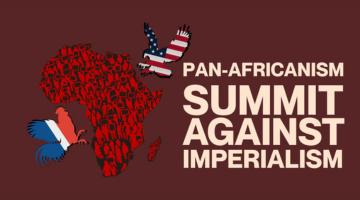 The Pan-Africanism Summit Against Imperialism (PASAI) will be held on May 11 and May 12 in Nairobi, Kenya. It is organized as a counter-summit to the France-Africa summit taking place in Nairobi at…
 Navid Zarrinnal is an Iranian journalist and host of The Colony Archive podcast. He joins us again from Iran to discuss the fragile "cease fire," Trump's threats, the Strait of Hormuz, and how Iran's…
 Beliefs in white supremacy and manifest destiny are at the heart of Donald Trump’s actions and his appeal to millions of people.