The Ethiopian government made a strategic decision to control most of the Nile River that flows into Egypt and Sudan.
“The GERD will be Africa's largest hydroelectric plant when it comes into full operation.”
The satellite images are frightening. Prior to this summer’s’s filling of the Grand Ethiopian Renaissance Dam (GERD), countries downstream from Ethiopia had free access to the flowing waters of the Blue Nile. On 15 July, Ethiopian Prime Minister Abiy Ahmed announced that the GERD, a gravity dam under construction since 2011, had successfully reached its goal of a first filling. The reservoir to which Ahmed refers is the size of Greater London and is estimated to take at least five years to fill. Recent photos of this same area demonstrate a reduced water flow northward towards Sudan and Egypt. Such a propitious collection of water for Ethiopia will necessarily be devastating to the countries whose life depends on these waters, namely Sudan and Egypt. Ahmed’s announcement came just one day after leaders from Ethiopia, Egypt and Sudan met in a virtual summit and agreed to resume talks on the controversial dam.
Since it was revealed that the GERD is now holding back water and will contain an approximate 4.9 billion cubic metres (bcm) of the Blue Nile's water after this year’s rainy season, this struggle for water has put the region at risk of military conflict. In another four to six years the reservoir that sits behind the GERD is expected to reach 74bcm. The GERD, still under construction, will be Africa's largest hydroelectric plant when it comes into full operation with a price tag of $4.8 billion (€4.3 billion). It is expected to be completed in 2022 with the potential to generate 6,000 megawatts of energy. Meanwhile, this first filling is said to provide enough water to test the dam’s first two turbines.
“The reservoir to is the size of Greater London and is estimated to take at least five years to fill.”
While both Sudan and Egypt appealed to the United Nations earlier this year to stop the opening of the dam’s operations in July, little is mentioned in mainstream media about how this dam will necessarily compromise both countries’ food security. Take for instance, the fact that Egypt depends upon the Nile for almost all of its water. It’s not hyperbole when Egyptian Foreign Minister Sameh Shoukry states that the dam presents an existential threat to Egypt. According to Shoukry, a 2 percent drop in the Nile’s flow would result in the loss of 100,000 acres of farming land and one million jobs.
During talks in June, UN Under-Secretary-General Rosemary DiCarlo told a videoconference that “transboundary water cooperation is a key element in the implementation of the Sustainable Development Goals (SDGs),” noting that “climate change, combined with projected demographic growth and socio-economic changes, will increase water management challenges worldwide, not only for Blue Nile riparian countries.” How this will play out in the immediate future is yet to be seen as Egypt’s and Sudan’s worries of water poverty are backed up by data and IPoE studies.
Viewed from the Egyptian perspective, by unilaterally filling the reservoir, Ethiopia is seeking to establish unfettered control over a transboundary river, a material breach of the 2015 Declaration of Principles signed by Egypt, Ethiopia and Sudan which stipulates that the filling and operation of GERD be in line with the guidelines and rules agreed between the three countries.
“The dam presents an existential threat to Egypt.”
Still, the Ethiopian government is intent on moving forth with its plans to open all operations of the dam as scheduled even to the detriment of the loss of foreign aid. The US government brokered talks between all three countries in February 2020 and as a result of the breakdown of the talks, the US is withholding some aid to Ethiopia over the issue. There are legal solutions underway by all parties involved, some involving ecological specialists and even a lawyer here and there who have attempted to balance historical treaties with current human rights and ecological demands.
Take for instance the fact that the GERD’s reservoir has the capacity to hold 88 percent of the mean annual flow of the Nile River when measured from Egypt’s southern border city, Aswan. It is beyond reasonable that Egypt and Sudan be concerned by this fact alone. But the subject grows in complexity as the GERD is located where it can dam the Blue Nile just before it leaves Ethiopia. This means that the Ethiopian government made a strategic decision to control most of the Nile River freshwater that flows into Egypt and Sudan. It is estimated that this would directly affect the lives of over 140 million people in both countries.
“Egypt’s and Sudan’s worries of water poverty are backed up by data.”
Because of the GERD’s location and based on international environmental law principles -- and according to an excellent article on this situation by Egypt expert and water policy analyst Amal Kandeel – a specific techno-legal process should have guided the planning and implementation of the GERD, based on its status as a transboundary project with international human rights and security consequences. Kandeel notes, “Ethiopia has been developing the GERD without encouraging downstream countries in material issues that affect them or allowing them a full, independent evaluation of the GERD through Environmental and Social Impact Assessments (ESIAs),” adding, “ESIAs are one of the ABCs in applied international environmental law and customary development law, are required by law, and are most useful before a country develops any project that necessitates it.”
Currently, Egypt, Sudan and Ethiopia are engaged in renewed talks on the GERD which are mediated by the African Union (AU) in an attempt to solve the ongoing dispute over the mega-dam. The US, along with the EU and South Africa, the current president of the AU, are observing the ongoing talks. Throughout talks from last year until July, Egyptian Foreign Minister Shoukry underscored that his country does not want punitive measures from the UN Security Council against Ethiopia. Like Sudan’s government, both countries want to prevent any negative repercussions from the stalled Grand Ethiopian Renaissance Dam (GERD) negotiations and to move forward to discuss the water rights of all three countries. Egypt had called on the UN Security Council in June to intervene in the GERD dispute in order to help Egypt, Ethiopia and Sudan continue their negotiations, in accordance with international law.
Julian Vigo is a scholar and filmmaker who has worked in the fields of ethnography, media studies, critical theory, gender studies, and visual culture and has taught at universities throughout the Americas, Europe, Asia, and Africa. Julian Vigo is also a permaculturalist, dj, yogi and human rights activist.
COMMENTS?
Please join the conversation on Black Agenda Report's Facebook page at http://facebook.com/blackagendareportOr, you can comment by emailing us at comments@blackagendareport.com

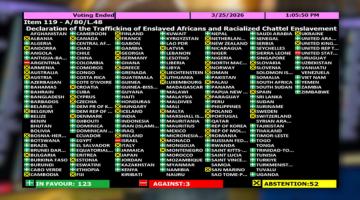
 In this week’s segment, we discuss the impact on the voting rights of Black people if the SAVE Act is signed into law. But we begin with a discussion of an historic vote at the United Nations which…
 Kwesi Pratt Jr. is General Secretary of the Socialist Movement of Ghana.
 The SAVE Act would require proof of U.S. citizenship to be presented in person in order to register to vote in this country and would disenfranchise millions of people who are currently able to vote…
 Russia finally makes good on promises to help Cuba, but its level of commitment is unclear. The left are clearly immobilized, even as Iran demonstrates how to fight back.
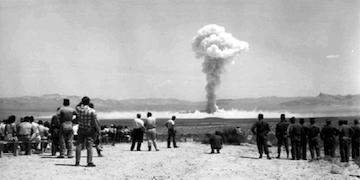 “We are not freeing ourselves from centuries of imperialism and colonialism only to be maimed and destroyed by nuclear weapons.”