The National Museum of African-American History and Culture continues referring to Kwame Ture as Stokely Carmichael, a name he had not used for many years before his death. Image: National Museum of African-American History and Culture
The U.S. is careening towards economic and military disaster, a moment when the Black radical tradition is missing but badly needed.
The celebrated Pan-African revolutionary who was born Stokely Carmichael became known as Kwame Ture circa1969 at the age of 28. He died in 1998 at the age of 57, which means that he was called Kwame Ture for at least as long as he was known by his more well-known birth name.
A museum dedicated to Black history should know this easy-to-discover fact, but oddly, the National Museum of African American History and Culture, part of the Smithsonian Institution, seems unable to provide this information and still uses the name Carmichael. Either it was unknown to the museum’s curators, which is unlikely, or it was deemed inconsequential or inconvenient. Perhaps it was feared that Ture‘s choice of names in honor of Kwame Nkrumah and Sekou Ture would upset museumgoers or, more likely, the politicians and wealthy white people who are depended upon for funding.
Not only does the museum insist on using the name Carmichael when they should use Ture, but a current exhibit about Historical Black Colleges and Universities (HBCUs) omitted any mention of the police killing of two young Black men at Jackson State University in Jackson, Mississippi, on May 15, 1970.
The museum is not an outlier in this regard. I raise these questions because of the need to examine a larger and very critical issue for Black people. Our radical history is being erased in ways big and small. That erasure prevents the kind of analysis that is needed in this country, as Black people are exploited and oppressed in new and terrible ways and the duopoly begins a war in Iran that may well be written about in history books as the beginning of World War III.
While establishment institutions may try to justify their purge of our history, it is important to keep in mind that Black radical politics were once very much in the mainstream. Many prominent Black people who are revered and respected were also leftists and celebrated that political orientation. While their works may be well known, their political affiliations now rarely receive attention.
The poet Langston Hughes is almost always mentioned on any list of Black notables. Very few people are unaware of his role as a cultural leader in the Harlem Renaissance and as one of the nation’s best-known poets. A line from his poem Harlem became the title of Lorraine Hansberry’s iconic play A Raisin in the Sun which is still performed regularly years after its 1959 premiere on the Broadway stage.
Hughes’ stature is unquestioned but he is rarely mentioned as a committed leftist who joined other Black socialists and communists in Spain during that country’s civil war that raged from 1936 to 1939. Given the sorry state of education in the U.S., and the watering down of Black history, no one should be embarrassed if that fact is unknown to them. Although if one looks hard enough, this chapter in Hughes’ life can be found even in a Facebook post. Hughes reported on the war for a Black newspaper, the Baltimore Afro-American, which means that Black people all over the country knew that Hughes and Paul Robeson and others were in solidarity with a socialist fight against fascism.
Thanks to Hughes and others during the days of Jim Crow segregation, in what was considered a historical low point, Black readers around the nation knew about Black involvement in the Spanish Civil War. Yet today we are told that Black people should be unconcerned with what happens in the world because it isn’t our fault that Donald Trump is president and white people are to blame for every calamity because they didn’t vote for Kamala Harris. The Trump administration's surveillance state and its wars of aggression have been declared “none of our business,” and social media memes and videos elevate this idea that we should party and play without giving thought to events in the wider world because they are now said to have nothing to do with us.
Who are the Black thought leaders now that the U.S. state grows more openly fascistic by the day? While we are exhorted to ignore domestic and international events happening around us the duopoly parties give support to this latest war that violates the Nuremberg Charter’s “crimes against peace.” Who is the Kwame Ture of this day? Where are the radical voices that can provide guidance and analysis at this critical juncture of history? The late Jesse Jackson gave voice to the struggles of the Palestinian cause and to the Cuban revolution and to the fight against South African apartheid, but even at his funeral, former presidents Bill Clinton, Barack Obama, and Joe Biden were in attendance. They were among those people whose actions Jackson publicly opposed and who, in successive administrations, built a bipartisan consensus for imperialism abroad and neo-liberalism at home.
There was a time when Ture’s name was a household word and his politics were shared by the masses of Black people. He was a national organizer of the All-African Peoples Revolutionary Party (A-APRP) in the U.S. Now, Black radical history is all but forgotten when it is most needed. While unemployment and mass incarceration climb, so does the bailing out of banks, billionaires and the military industrial complex. While gentrification ravages communities and artificial intelligence steals jobs, the people who are elevated as cultural and political leaders either have nothing to say or have chosen to censor themselves. Voices that can connect the dots between what is now called the Epstein Class, imperialism, capitalism, and a “democracy” which is anything but democratic, are very badly needed. Of course, it is not coincidental that the Black left have been largely silenced at this moment. The fifty year long counter revolution has done its job quite well.
So much so that even after the hated Trump sent federal troops into Washington DC and Chicago and Memphis to practice racial profiling on Black people, the “it’s none of our business” crowd still had nothing to say. We have gone from a Black radical tradition to silence, even when Black people are specifically targeted.
Even worse, the latest war of aggression against Iran is treated as theater. A now viral video shows young Black women in uniform dancing to a hip-hop tune with a graphic, “Just touchdown in Iran,” as if going off to an illegal war is just another online “influencer” hustle. How can young people be better educated when years of endless war propaganda have normalized what was once rejected?
Kwame Ture attended Howard University, an HBCU that played a formative role in his political education. Kwame Nkrumah, president of Ghana, until he was deposed by a U.S.-backed coup, also attended an HBCU, Lincoln University in Pennsylvania. Now, Nkrumah might be called a “tether” who didn’t deserve to be in the U.S. at all.
If the Black radical tradition is not quickly revived, we will go down to destruction with the rest of a collapsing, failing society and not even know why we have been defeated. Confusion reigns because radical voices are still too few. The struggle, which will determine how and even whether we survive the continuing onslaught, will depend upon how well we have educated ourselves. The Black radical tradition is an essential part of that learning.
Margaret Kimberley is the author of Prejudential: Black America and the Presidents. You can support her work on Patreon and also find it on Twitter, Bluesky, and Telegram platforms. She can be reached via email at margaret.kimberley@blackagendareport.com.

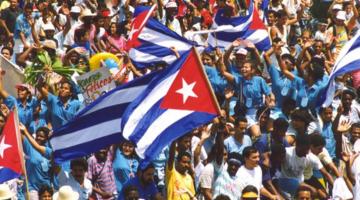 Condemnation of the U.S. blockade against Cuba must be translated into acts of solidarity to defend the nation that has done so much for the world.
 In this week’s segment we hear about Cuba, the challenges of Caribbean unity, and resistance to U.S. efforts to destroy the revolution. But we begin with Iran and discuss how its defense capabilities…
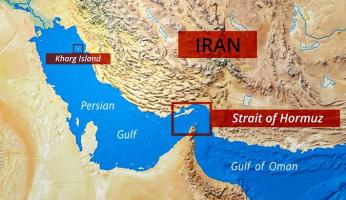 Iran is a more formidable foe than the US anticipated. The U.S. goal of regime change failed because of Iran's military power and determination to defend itself. In Washington the "Secretary of War"…
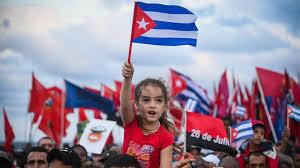 The United States has attempted to defeat the Cuban revolution from its earliest days and for more than 60 years has embarked on sabotage, economic coercive measures, and now a three-month long…
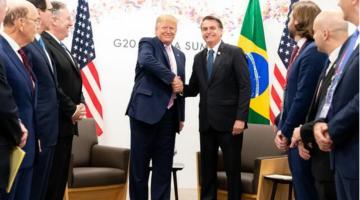 It’s up to Americans to stop the Trump administration from using U.S. power to strong‑arm Brazil and interfere in their elections.