“If you can do that to Cuba because somebody doesn't like the Cuban revolution, then how do I know that you don't do that to me tomorrow?”
After island-wide blackouts this week, power is slowly being restored to the Republic of Cuba. Yet the literal darkness that engulfed Cuba following the collapse of its energy grid can be seen as an ominous sign for the future of the Cuban Revolution. The blackouts were a result of Donald Trump’s intensification of US terrorist actions against Cuba. Since the 1959 Revolution, US regimes have sought to punish Cuba. Dwight Eisenhower established an embargo on Cuban sugar in 1960. After the US was embarrassed by the “Bay of Pigs,” John F. Kennedy’s regime passed the Foreign Assistance Act to establish a total blockade of the island, while promising to punish any country that provided assistance to Cuba.
Every US regime has kept in place the embargo against Cuba. But Trump, emboldened by his successful “regime change” in Venezuela, has gone farther than previous US presidents. With his 29 January 2026 Executive Order, Trump declared the Government of Cuba to be an "extraordinary threat…to the national security and foreign policy of the United States” and imposed a fuel blockade on the island nation, on top of the already-existing 62-year-old blockade. Trump threatened to punish any country providing oil to Cuba.
Not a single country dared defy the US. Cuba has been abandoned, not only by its Caribbean brethren, but by its so-called allies Mexico, Russia and China.
Jamaican Prime Minister P. J. Patterson, in a statement signed by a half dozen former leaders of the Caribbean, has described Trump’s actions as inflicting “unconscionable suffering upon” and “cruel punishment of” Cuba’s eleven million citizens. The fuel embargo precipitated a crisis in the country far exceeding that of the “Special Period” which followed the collapse of the Soviet Union.
The coming weeks will be critical. It is said that the collapse of the Grenada Revolution produced a spiritual crisis within the Anglophone Caribbean Left over the prospects of progressive change in the region. What would the collapse of Cuba engender? It would not only signify a crucial victory in the counter-revolution against socialist projects in the Global South, but a significant victory for the forces of fascism in the Americas.
Has the Caribbean Left been so decimated, battered, and gutted that only the reactionary forces remain — and Cuba’s collapse would mean nothing?
It was not that long ago that Cuba was not merely a beacon of hope for the Caribbean, but a source of material aid. It also was not long ago that many Caribbean nations pledged to defend Cuba’s sovereignty against US pressure. On December 8, 1972, for example, Guyana, Jamaica, Barbados, and Trinidad and Tobago established diplomatic relations with Cuba, defying US pressure to isolate the island. In 1975, Jamaican Prime Minister Michael Manley visited Cuba, initiating a series of exchanges in engineering, sports, education, and, especially, healthcare that would have an immeasurable impact on Jamaican society. Cuba trained hundreds of Jamaican doctors, nurses, technicians, and pharmacists while Cuban medical specialists have assisted thousands of Jamaicans. Those exchanges no longer exist as the current Jamaican government (among many others in the region) has caved in to US pressure.
In 1977, Manley was interviewed by Gil Noble for the legendary public affairs television program, Like It Is. The interview represents something of a lost genre: wide-ranging, thoughtful, and literate. Noble’s questions are probing and smart and he allows Manley the time and space to provide expansive and considered responses. At one point in the interview, Noble asks Manley about his and the Jamaican government’s relationship to Cuba. Manley responds by stating that Cuba is “fundamental” and “non-negotiable” – as a Caribbean country, as a Third World country, and as a member of the global community of nations. Manley comes to the defense of Cuban sovereignty, while pointing to the rank hypocrisy of sanctioning Cuba when there is “not one economic sanction against the ultimate leper of the international community, [apartheid] South Africa.”
Today, when it comes to the sanctioning of lepers, we could easily replace “South Africa” with “Israel.” But more importantly, we must join in the defense of Cuba’s sovereignty before it becomes another island of fascism in the Americas.
We reprint an excerpt of Gil Noble’s interview with Michael Manley below.
Cuba is Fundamental to Us
Michael Manley
[The issue of Cuba] is very, very fundamental to us. It's a non-negotiable item on our agenda. We start from certain positions of principle.
One, Cuba is our nearest neighbor.
Two, Cuba is a member of the Third World, like us.
Three, Cuba fights at our side for changes in the world economic system.
Four, we find Cuba the most principled country to deal with. They operate on a basis of respect for sovereignty and non-inference in other people's internal affairs. They have an internationalist policy that if you say to them, come and be my friend. We think you have certain skills that are interesting. We think you've done certain things that are interesting. We would like to have a look at what you've done. Would you like to cooperate with us in our field? They say fine. If you don't want to cooperate, they say fine.
We have long since understood that they are on a particular path of development that is obviously massively supported by their people and which is a product of their objective circumstances.
Their revolution arose out of the horrors of one of the worst tyrannies the world had ever known. And a lot of their experience is conditioned by that fact.
We are a totally different thing. We had a different kind of society, different traditions. We had a functioning plural democracy. And we're on what we call our democratic socialist path of development which has certain points of similarity with theirs but very substantial points of difference with theirs —and we respect each other.
But even more important than all of that, and this is what is non-negotiable to us, Cuba is a legitimate part of the world and this hemisphere. And it has one of the most legitimate governments in the world because legitimacy is a function of popular support and nothing else. Nothing else legitimizes except people.
And no country in our view, no country has the right to impose sanctions upon Cuba or any other country that has legitimacy to us. Therefore, it is non-negotiable that Cuba must be accepted as a full free and untrammeled member of the world community and the hemispheric community.
And if that is not so, we can't make it so. I don't say this in arrogance. I'm talking about what we stand for, not what we can make happen, but what we stand for, we will not move over and we'll pay any price for. And you know, looking at it from a practical point of view, you could say this. If you can do that to Cuba because somebody doesn't like the Cuban revolution, then how do I know that you don't do that to me tomorrow, that you don't like something that I do?
Noble: Would you say then that this is a reason why you are dissatisfied with the absence of sanctions against South Africa while there are sanctions against Cuba?
It does not… Well, I'm not an easy person to embitter but that makes me as near to bitter as anything in the contemporary world. is something that I said in Maputo actually at a conference to which I was invited this year that it really is a tragic commentary on human values in the world that there are still sanctions against this really very brave and brilliant social and human experiment which is taking place in Cuba even if you don't agree with the methodology it's a remarkable experiment and you can leave sanctions against that country and apply not one sanction.
Well, they're now talking about an arms embargo, but not one economic sanction against the ultimate leper of the international community, South Africa.

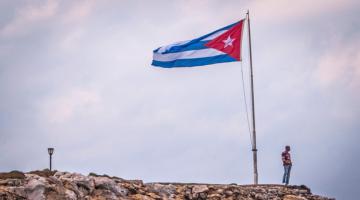
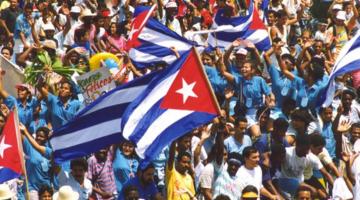 Condemnation of the U.S. blockade against Cuba must be translated into acts of solidarity to defend the nation that has done so much for the world.
 In this week’s segment we hear about Cuba, the challenges of Caribbean unity, and resistance to U.S. efforts to destroy the revolution. But we begin with Iran and discuss how its defense capabilities…
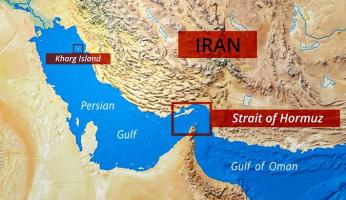 Iran is a more formidable foe than the US anticipated. The U.S. goal of regime change failed because of Iran's military power and determination to defend itself. In Washington the "Secretary of War"…
 The United States has attempted to defeat the Cuban revolution from its earliest days and for more than 60 years has embarked on sabotage, economic coercive measures, and now a three-month long…