The threat of U.S. military action in Nigeria has little to do with protecting Christians and everything to do with domestic U.S. politics and international political games. The "genocide" claim obscures a far more complex reality of state failure and economic collapse.
A dangerous fiction is being weaponized against Nigeria, threatening to plunge an already beleaguered country into a deeper abyss. The narrative of a systematic "Christian genocide," used to justify President Donald Trump's threat of a "guns-a-blazing" U.S. military intervention, is not just an oversimplification. It is a deliberate distortion designed to serve external geopolitical interests. This narrative constructs a stark, binary world of Muslim perpetrators and Christian victims, a story crafted for moral outrage. Yet the response from Nigeria's own leadership, characterized by what can only be described as groveling accommodation, reveals a deeper crisis of sovereignty that transcends the immediate military threat.
The central claim of a "Christian genocide" is a profound falsehood that collapses under the weight of evidence. As the Armed Conflict Location & Event Data Project reported, “While Christians make up roughly 50% of the population, violence in which Christians have been specifically targeted in relation to their religious identity accounts for only 5% of reported civilian targeting events.” Even Trump's own envoy for Arab and African affairs, Massad Boulos, acknowledged that Boko Haram has killed more Muslims than Christians. The majority of victims of both Islamist insurgencies and criminal banditry are Muslims, simply because these conflicts are concentrated in Nigeria's northern and northwestern regions where Muslims form the demographic majority.
The threat of U.S. military action against Nigeria, justified by claims of a "Christian genocide," did not emerge in a vacuum. Trump’s remarks came after weeks of lobbying by US lawmakers and conservative Christian groups and reflect renewed domestic political pressure to appear tough on the marginalisation or persecution of Christians abroad, a theme that resonates strongly with parts of his rightwing, evangelical base. This theme of persecution of Christians is a very politically charged theme for evangelicals. The threat is, first and foremost, a signal to a US domestic audience, designed to energize a key part of Trump's political base with the spectacle of a righteous, guns-blazing “crusade.”
The central claim of a "Christian genocide" is a profound falsehood. There is no state-sanctioned, religiously-motivated campaign to exterminate Christians in Nigeria. This label, a term with specific legal and moral weight, is being grotesquely misapplied. The accompanying narrative that violence is driven purely by Islamic extremism targeting Christianity wilfully ignores a fundamental, documented reality: the primary victims of the most prominent Islamist insurgent groups, Boko Haram and ISWAP, have been Muslims in the northeast who reject their extremist ideology. To claim otherwise is to disregard the experience of millions and collapse a multifaceted security landscape into a singular, misleading religious war. Furthermore, the assertion that the US threat of military action in Nigeria is primarily motivated by humanitarian concern is a cynical falsehood. History provides a clear lesson, from Iraq's oil to Libya's strategic position: humanitarian rhetoric has consistently served as a cover for resource grabs and geopolitical maneuvering.
The "Christian genocide" narrative also serves a crucial propaganda function in the broader global landscape: it provides ideological cover for Zionism. By loudly promoting the false specter of mass religious persecution by Muslims in Nigeria, figures like Trump and Texas senator Ted Cruz are advancing a core Zionist talking point. This argument claims that the world, driven by antisemitism, unfairly singles out Israel while ignoring what they characterize as "real" persecution of religious minorities elsewhere, in this case, Christians by Muslims. The manufactured crisis in Nigeria is used to create a false moral equivalence, suggesting that if Muslims are committing genocide in Africa, then the world has no standing to criticize Israel's documented genocide in Gaza. This is a deliberate, cynical strategy to paint Muslims as perpetual aggressors and Israel as a victim of biased scrutiny.
The threat of military action itself, however, is not only politically cynical but also militarily reckless. It comes against the backdrop of a significantly diminished U.S. presence in the region, following the American military's expulsion from Niger in 2024. This expulsion upended the Pentagon's counterterrorism strategy and stripped the U.S. of its major drone base in Agadez, a $110 million facility that was once the largest U.S. Air Force-led construction project in Africa. Unlike its ongoing, intensive bombing campaign in Somalia, which is buttressed by the major strategic hub of Camp Lemonnier in Djibouti, any unilateral U.S. operation in Nigeria would be a massive logistical undertaking with no secure regional foothold. Nigeria is a vast country, roughly the combined size of California, Nevada, and Utah, with complex terrain and porous borders. Launching a sustained military campaign under these conditions would be a strategic quagmire in the making. This fundamental logistical reality reveals Trump's "guns-a-blazing" threat for what it is: less a serious military plan and more a blunt instrument of political coercion, designed for domestic consumption with little regard for the complex realities on the ground.
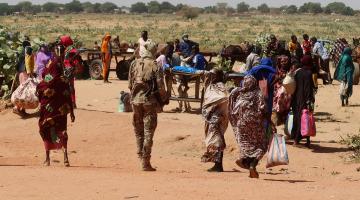
The truth of Nigeria's crisis is far more complex than this simplistic coercion acknowledges; it is a mosaic of violence rooted in governance failure, economic despair, and ecological collapse. The nation is not fighting one war but several distinct, though sometimes overlapping, conflicts. In the Northeast, the Boko Haram insurgency is fundamentally a political and economic crisis, thriving in a region historically abandoned by the state, where poverty, lack of education, and deep-seated marginalization are the true drivers of recruitment. In the Northwest, an epidemic of banditry represents not holy war but pure economic violence. Heavily armed criminal gangs, born from a vacuum of state presence and a collapsed rural economy, engage in mass kidnappings and cattle rustling for profit, targeting Muslim-majority communities with brutal impartiality.
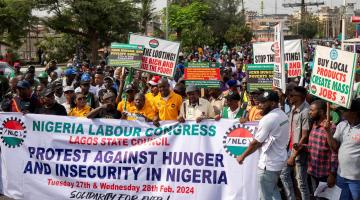
Beneath this violence lies its primary engine: a collapsing economic base. The recent, brutal policies of ending the fuel subsidy and floating the Naira, acts of economic shock therapy dictated by international financial institutions, were not mere missteps. They were a qualitative shock to the system, triggering a quantitative explosion in costs. The price of fuel, food, and transport skyrocketed overnight, plunging millions into unprecedented hunger and transforming widespread poverty into a state of acute crisis. This economic immiseration is the tinder for all other conflicts; it pushes desperate young men into criminality and turns manageable competition over dwindling resources like land and water into a desperate, zero-sum struggle for survival. The failure of the Nigerian state to protect its citizens from this economic violence is not a root cause but a symptom of a deeper dynamic, where the political class manages the economy for its own benefit and that of foreign capital, rather than for national development and the welfare of its people.
The struggle in Nigeria is not between the church and the mosque. It is a struggle between the vast majority of Nigerians, the poor, the working class, the peasantry of all faiths, and the forces, both internal and external, that profit from their division. The threat of foreign intervention, however logistically unsound, is designed to shatter the solidarity needed to win that struggle. The most powerful resistance will be a united front that sees this lie for what it is, a tool of division and distraction, and fights for a future where Nigeria's destiny is determined by its own people.
Tunde Osazua is the National Co-Coordinator of the Black Alliance for Peace and a member of the Steering Committee of the International Campaign to Free Kamau Sadiki.

 The U.S. has been temporarily rattled in its regime change effort against Iran. Iranian resistance, hubris on the part of the U.S., and Donald Trump’s personal instability combined to undo a twisted…
 A conversation focusing on U.S. actions against Iran explains why the imperialist drive for domination will actually lead to a superpower becoming much less powerful.
 “...it is like a knee-jerk reaction in the U.S – this consistent, insistent and persistent anti-Caribbean policy in the U.S. from 1776 to the present.”
 Most of the world would be at greater ease if Iran had a nuclear bomb.