BAR Book Forum editor Roberto Sirvent interviews Dash Harris Machado.
Roberto Sirvent: Can you please share a little bit about your background, including how you became involved in multi-media, writing, political education, and organizing?
Dash Harris Machado: I always liked to read and write and most of all research and find out the “why” of the matter. My parents encouraged this. My mother ensured to instill Black consciousness and we applied it hemispherically. I started NEGRO: A docu-series about Latino Identity in 2010 on a trip to Brazil, because I wanted to document the historical and contemporary lives of Black Latin Americans from our point of views, not those “studying a subject,” not those speaking for us or over us. Our perspectives which have always been there but are silenced, erased or not even considered. I wanted a resource to point to, so I made one. The NEGRO docu-series led me to build relationships with people and organizations all throughout Latin America, which then led me to co-found AfroLatinx Travel with Javier Wallace. Many of the trips included those people and organizations that I met over a decade ago. And not only trips, with my freelance writing, I am able to highlight Black individuals and movements in the region. When we entered into the pandemic, I pivoted to online classes, courses and workshops with Radio Caña Negra with our podcast and training series “AntiBlackness in the Latine Community” as well as our AfroLatinx Travel courses on Black Latin American History and Contemporary Topics. I draw from over 15 years of independent research, observation, investigation, living in, traveling and connecting with groups and individuals throughout the region over the years. Our futures are tied.
You wrote an essay titled, “No, I’m not a Proud Latina.” Can you share what motivated you to write this piece?
Simply. Because I am not. The term “Latino” never included Black people in our fullness. The hegemony of Hispanidad, of Iberian colonization counted on our exploitation and then extermination. What Latin America and “Latinos” are known for are cultural and historical legacies of primarily African descendants and Indigenous peoples of the region. The region was borne through genocide, violence, religious, social, economic and racial subjugation and continues this through normalized white social order, oppression and appropriation. Nothing to be proud of.
What are some of the more insidious ways that we see anti-Blackness structuring discourses, habits, and practices in Latinx and Latin American communities?
One of the biggest is not disaggregating Latine and Latin American communities racially and also along ethnic lines essentially forwarding the erroneous discourse of the “raceless Latino” and/or as a catchall for “people of color” flattening huge diverse populations into a beige bubble. The blatant economic, racial and social dishonesty, the repeating of archaic tropes with little interrogation, critique or reflection and the dedication to myths of a “more benevolent” colonizing force as a “gotchya” to the U.S.. The preservation of these lies also keeps Latine orgs and individuals from having to do the necessary reflection and work to dismantle antiblackness. They can beg it off as a “U.S. thing,” not an “internal problem.” The over-reliance and constant centering on mestizaje, and a “mixedness” rhetoric obscures the lived and material experiences of those African descendants racialized as Black. The constant derailment of nationalism as a path to racial equity, (we are all X nationality and all are equal) as well as the rise of these ancestry and blood quantum tests are being weaponized and used as an escape hatch from confronting antiblackness and one’s participation and advantages from it. Quoting Javier Wallace on the cautioning against browning of Latinidad:

On Twitter, you’ve expressed concern with various commentators (including academics) who claim that the construction of race is “different” in Latin America than in the U.S. Why is it so misleading to make this claim? And why is it so prevalent to hear Latin Americans insist that they don’t have a race problem?
Latin America is not a racial Disneyland and that is how they continue to sell it. It needs to stop. It is grossly dishonest and is actually unethical if they are to be tasked as “educators.” There’s simply nothing “different” about the white social order and domination in the U.S. and in the various countries in Latin America. The only obvious differences would literally be the languages only. The notion that because the region has large quantities of mixed populations somehow “absolves” them of racism and antiblackness is childish and an old rhetoric and mechanism to precisely continue racism and antiblackness under the guise of “nationalism.” “We are all (insert nationality) and are the same.” Complete bullshit.
It also begs the question of: Exactly HOW did these mixed race populations come to be? The violent history of sexual assault and abuse to create “multi-racial” nations and the historical and contemporary aspirations to marry or procreate as white as possible to “improve or advance” oneself is always bypassed. The social order was implemented by white European colonizers on the backs of enslaved populations of Africans and Indigenous peoples. These groups of Europeans terrorized and kept Africans in line through genocide, extreme violence, incarceration, laws, policies, regulation, media, eurocentric “tradition” and ideas of “honor” and “respectability” that excluded and continue to exclude us from their ideas of humanity. These dominant groups which came to include mestizos and castizos continue these antiblack traditions by capital, access, and stolen wages and labor hoarded to benefit the dominant groups of Europeans, their descendants and those approximating their whiteness. Black Lives Matter is being used by Spanish and Portuguese speaking Afrodescendants throughout the entire region because the police violence, state-sanctioned murders, blocked access to resources and dignified housing, education, healthcare and safety is systemically denied. Tell me, what is so “different”?
You recently posted a thoughtful reflection on Tanya K. Hernández’s new book, Racial Innocence, which we featured in the BAR Book Forum earlier this year. Why do you think this book is so important for non-Black Latine people to read?
I would say that a lot of nonBlack Latine people in general know very little, if anything, about Black people and do not care to know. All they do is repeat stereotypes and tropes. There is very little interrogation, challenge or reflection on what they deem as tradition, culture and “the norm.” Oftentimes, those traditions, “culture,” and norms they defend to the teeth are racist, antiBlack and anti-Indigenous. The book lays bare and clear the antiblackness ingrained in not only tradition, culture and norms, but also behavior, law, attitudes, actions and the various networks of people and institutions who keep it going. Organizer Evelyn Alvarez said it best with “these systems are upheld by people in choice” and Professor Hernandez reveals all those choosing to be inhumane vessels of white pathology. It took me longer than I expected to finish because the book is filled with my ongoing lived experiences. There are court cases, anecdotes, stats, figures and much more but the case study that sums up my experiences was: “in a 2017 survey of college students, Afro-Latines said that on-campus Latine spaces are among the most violent, “My entire life, Latino spaces have always been the most violent for me. To this day, I can’t enter a space where there are only Latinos.”
How can BAR readers support your work?
They can hire me through their organizations, schools, colleges, universities and companies, and/or take my courses, classes, workshops, one-on-one and group coaching, subscribe to my YouTube, Patreon and contribute to our mutual aid efforts! They can also watch and share NEGRO: A docuseries about Latinx Identity, ask their colleges and universities to purchase it and support the upcoming fundraiser to continue the docu-series. You can sign up for my AfroLatinx Travel and Radio Caña Negra workshops, classes, group and one-on-one coaching sessions, listen to the Radio Caña Negra podcast, and follow us on social media platforms and most importantly apply the knowledge and reflection that they learn to their daily lives.
Dash Harris Machado is a multi-media producer, doula, Apetebí and facilitator. She is the co-founder of AfroLatinx Travel, and facilitates classes on Black Latin American History & Contemporary topics with Javier Wallace.
Roberto Sirvent is editor of the Black Agenda Report Book Forum.

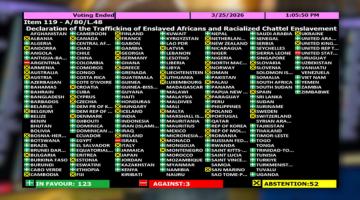
 In this week’s segment, we discuss the impact on the voting rights of Black people if the SAVE Act is signed into law. But we begin with a discussion of an historic vote at the United Nations which…
 Kwesi Pratt Jr. is General Secretary of the Socialist Movement of Ghana.
 The SAVE Act would require proof of U.S. citizenship to be presented in person in order to register to vote in this country and would disenfranchise millions of people who are currently able to vote…
 Russia finally makes good on promises to help Cuba, but its level of commitment is unclear. The left are clearly immobilized, even as Iran demonstrates how to fight back.
 “We are not freeing ourselves from centuries of imperialism and colonialism only to be maimed and destroyed by nuclear weapons.”