The immense “buying power” of African Americans, we are told again and again, makes us a huge economic power. So harnessing this power by changing the consuming habits of black America, the story goes, is an essential pre-requisite for black uplift. We've all heard it many times, from the screen, from the pulpit and elsewhere. But is any of it true? Does this popular understanding confuse black income, and even black debt with black wealth? Where does this misinformation come from? And does the emphasis on “buying power” as agency denigrate collective action in favor of “lifestyle” activism? Dr. Ball opens the door to this vital discussion.
The Myth of Black “Buying Power”
by Dr. Jared A. Ball
Achieving economic clarity is a bit more difficult than it would appear. The myth of Black “buying power” resurfaced yet again in February as more “news” was released from African American/Black Market Profile (AABMP). The myth, now updated, projects that this “spending power” will reach $1 trillion by 2011. This mythology of an African America whose national economic strength rivals that of most countries is consistently misunderstood, improperly quoted and ultimately used to deny the outrageous inequality and exploitation this country still requires to maintain itself as the single superpower/empire.
First and foremost the initial report cited needs to be understood for what it is.
“The Market Profiles gather and synthesize the most recent findings from dozens of sources in order to help marketers communicate more effectively with these important consumer segments” (emphasis added).
So these numbers are floated not for their accuracy regarding Black people’s economic standing but for their ability to tell which corporations should more aggressively target their marketing (psychological warfare) towards African America to get what little money actually is held there.
Part of their projections are based on the percentage (30.2) of African American households whose income is more than $50,000 per year. Somehow this is meant to convey a sense of economic progress or sustainability. Not considered in this report is that if the poverty line in the U.S. (a number already itself designed to hide poverty) is set so as to only count those in poverty who live in households of 4 earning less that $20,000 annually then, of course, a $50,000 would appear stronger than it actually is.
The AABMP report, however, references for its numbers a study from the Selig Center for Economic Growth whose numbers also must be held in question. Their justification for suggesting in 2006 that that year would be one in which African America, as the “nation’s largest minority market,” would use their “economic clout” to “energize the U.S. consumer market as never before.” They cite as evidence such misleading statistics as:
-
Black population growth
-
Increased job opportunities
-
More education for Black America
-
Only 8.1% of Black America is over 65 years of age or at “career pinnacles” at which point wage increases “decelerate,” whereas, whites are 13.5% over 65.
-
Black people spend more than “non-blacks” on natural gas, electricity, telephone services and footwear and a higher proportion of their money on groceries, housing and women’s and girl’s clothing.
-
And this author’s personal favorite, that despite “a substantial gap in homeownership rates” this ’suggests a possible opportunity for market expansion in the years ahead.”
We must be clear. Income is not wealth. “Buying power” as a phrase and one measured in these ways offers so many illusions that contradict the previous point. Population growth and increased jobs (increased from what?) do not, in and of themselves, say anything about economic power. More education means little as well when advanced degrees are considered an absolute necessity for economic advancement (certainly still no guarantee) and even their own report (p. 9) shows that in 2005 only 19% of African America earned a Bachelor’s degree or higher and the percentage of that population who earned a graduate professional degree was so low as to only warrant an “N/A.”
It is also important to note that “buying power” is a confused phrase in that it, again, says nothing of a wealth Black people have little of but also suggests that this “power” is or can be for community uplift. The fact, again, that this is target marketing material means that by “power” they mean the ability to generate money for corporations to whom this spending will be geared. It does not mean that Black America has some un-tapped economic strength that can be marshaled to buy that which increases wealth (land, stocks, etc.) and speaks to the basics of colonial exploitation. That is, that the colonized are left only to purchase trifling gadgets and trinkets “footwear” and “clothes,” as opposed to land, stock and other capital most of which is sequestered among the tiniest elite minority.
And finally, it is sadly laughable that too many of us are fooled into thinking our power is squandered by poor purchasing habits, again, since this is all to which we have access anyway. The idea that land and stock is there waiting but we’d rather go to the mall for trinkets results from mass capitalist, white supremacist propaganda which too many of us have imbibed. So, in fact, the suggestion in 2006 that homeownership represents “a possible opportunity for market expansion” was a precursor to the damage and pain most are seeing only now; predatory lending, sub-prime scandals, mortgage and home foreclosure and the what United for a Fair Economy (UFE) recently reported as “the greatest loss of wealth for people of color in U.S. history… {upwards of} $200 billion.”
Black people, like most others, are an exploited, colonized population whose wealth-generating capabilities are, just as these reports really say, for an elite who have nothing to do with Black people. Black wealth resides in elite white enclaves here and abroad while African America devolves economically, politically and in terms of healthcare, education (quality of and access to), police brutality and mass incarceration. And even within Black (and Latin) America 25% of the households have 90% of the wealth demonstrating a great divide within communities where Black median net worth is already a pathetic and dangerously low $5,988 and $7,932 for Latin America compared to $88, 651 for whites. Black people have no money. We spend on credit and loans (none of which is considered for either of these studies) so as to project a “power” that we in fact are far from having. Rarely does anyone have in their pocket or account the $20,000 for a car or $30,000 (and way up) for one year of college. We take loans for these and other purchases which then count towards our “spending power.” The debt we fall into this way and others (i.e. credit cards) is counted as a “positive” by those to whom our pockets are perpetually emptied. But this is not and can never be “power.”
Anyone, including Black “leaders,” who parade fanciful numbers before their unsuspecting audiences so as to, again, suggest that irresponsibility is the cause of Black poverty need to be checked, vigorously. We need to get back to an increased intelligent and honest discussion of economics so we can be where Ture was when he left, as he and his comrades always said when answering a phone and saying goodbye, “ready for the revolution.”
Dr. Jared Ball is assistant professor of communication at Morgan State University, and one of the guiding minds behind voxunion.com, which we strongly advise our readers to visit.

 The ceasefire brings a sense of relief but not safety. Iran showed that the empire is not invincible, but the US commitment to the doctrine of hegemony has not changed.
 Keir Starmer and Trump are putting on a puppet show for the cameras. Behind the scenes, Britain remains a junior imperialist partner working for the destruction of Iran.
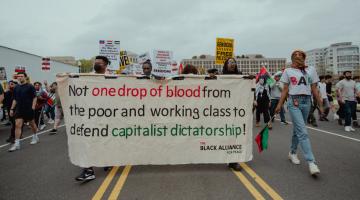 The Black Alliance for Peace marks nine years of fighting against U.S. imperialist brutality. Now the movement must transform imperialist wars into people's wars for liberation.
 The war on Iran is part of a class war against any country that refuses to open itself up for foreign profit. Understanding Iran means seeing its fight as part of the same struggle that defines the…
 “The chickens have come home to roost,” one resident said. “Our exact fears have come true.”