A Brief History of Neo-Colonial Rape and the “Freak Shows” of Black Women’s Bodies
“These sites of ‘disaster’ are created by the very ‘civilized’ men who then turn around and exploit the victims of their imposed ‘civilization.’”
Catharine MacKinnon’s book Are Women Human? is a text which interrogates the violence specifically targeting women throughout history. From beatings, to torture, to rape, to sexual subjugation, to murder, and to genocide, there are myriad examples that show how women are rendered insignificant in the cultural landscape of human rights. MacKinnon’s text asks how women can be considered people since, when placed next to legal renderings of other groups of people, women are excluded from similar protections. “Are women human?” remains a question of great significance today, as even those on the left consider us less-than. There is also the fact that, for many, women’s rights are considered “already won” and therefore part of an antiquated movement that should just simmer down.
The facts speak for themselves: women are still under-represented in employment in media, government, and education; women bear disproportionate responsibility for unpaid care work; while women are shown to make better use of loans, they are denied loans at a far higher rate than men; women will statistically be more prone to enlisting in credit repair services and accruing far more debt than men despite performing most of the world’s labor, earning on average 24 per cent less than men; and women are more likely to suffer from poor credit due to their relationships with men and through marriage. There are so many facts that show women are saddled with more work, lower salaries, and fewer economic benefits, no matter what level education they attain, no matter their financial investments, regardless of the few who manage to climb far up the ladder. While today, womanhood is still reduced to the superficial—“beauty,” attained or displayed through symbols of femininity, like hair, makeup, jewelry, and clothing—women’s realities are anything but decorative or camp. Women’s lives are still overwhelmingly difficult, as the burden placed on women to undertake unpaid domestic labor while being forced to pay more for beauty, hygiene, and health products stands in stark contrast to what men experience.
“Womanhood is still reduced to the superficial—‘beauty,’ attained or displayed through symbols of femininity, like hair, makeup, jewelry, and clothing.”
And for women of color these statistics are far worse when it comes to every single facet of black women’s existence—labor rights, partner violence, rape, homicide, human trafficking, and unethical medical treatments such as sterilization. Yet, you’d hardly know this with the many articles that claim feminism is “going too far,” to the recent labeling of women who name sexual harassment and assault as taking part in a “witch hunt,” men are being positioned as victims of women’s efforts to fight misogyny. Sexism is so normalized, any challenges to it are viewed as an unreasonable attack on men.
Then last month, acclaimed classicist and feminist, Mary Beard, painted herself into a corner over the Oxfam scandal. In response to reports that the former country director of Oxfam in Haiti, Roland Van Hauwermeiren, had bought sex from women and girls, Beard tweeted:
“Of course one can’t condone the (alleged) behavior of Oxfam staff in Haiti and elsewhere. But I do wonder how hard it must be to sustain ‘civilised’ values in a disaster zone. And overall I still respect those who go in to help out, where most of us [would] not tread.”
This kind of comment exemplifies the way women (particularly women living in the Global South and women of color) historically have been othered -- their humanity rendered less legitimate than men’s. Beard’s comments have been described as “genteel racism,” as well as patently sexist, and the reality is that they are both. This kind of response demonstrates the extent to which sexism has been normalized within the cultural subconscious of society, as well as the way the colonialist gaze positions dark-skinned bodies as provoking white man’s loss of “civility.”
“Beard’s comments have been described as ‘genteel racism,’ as well as patently sexist, and the reality is that they are both.”
Considering her work in Women & Power, which analyzes the cultural unconscious of misogyny, as well as her extensive work in the fields of ancient Greek and Roman civilizations, it is clear that Beard is skilled at analyzing misogyny in ancient cultures. Her failure to see it in today’s modern culture reveals a troubling (but common) blindspot. Indeed, her comments exist as part of a larger trajectory of British intellectual history and a long tradition of white, male colonization.
In response to Beard’s unfortunate tweet, Oxford lecturer, Priyamvada Gopal, couched this issue as yet another instance of structural racism, going on to make a satire of Beard’s tweet: “Obviously it’s not a great idea to randomly get your d**k out, rape people etc. But it’s not easy to be politically correct while in s**tholes. And overall I still respect people who head out to s**tholes ‘cos I sure as hell wouldn’t dream of it’.” Gopal went on to elaborate the problems of racism within Cambridge on Twitter and in her blog, to include the story of a “leading feminist” who told her, “that while we still battled misogyny here, racism was a thing of the past and it was outrageous of me to raise it as an issue.” Gopal concluded, “The sad truth is that among those who deny that racism is still a problem at Cambridge, there is a preponderance of white feminists.”
Terms like “civilized” beings, “disaster zones,” and “areas that most of us would not tread” are re-appropriations of the same patriarchal language that have historically kept whites the colonizers of dark-skinned bodies and males the proverbial “owners” of females. Beard’s phrasing suggests that it is not the male Westerner who is uncivilized, but rather his proximity to the non-Western “zone” and conditions of “disaster” that leads him to behave in this suddenly “uncivilized” way.
“Among those who deny that racism is still a problem at Cambridge, there is a preponderance of white feminists.”
Beard is not alone in thinking this way. Too many progressives cannot recognize misogyny when it happens within particular contexts and excuse it circumstantially. We see this in the way the left has excused prostitution and pornography, in terms of the vast numbers of women who are raped by relief workers in Syria, and when we look at the recently reported assaults on and harassment of female aid workers by male staff. But even if Beard’s words are not excusing the acts of rape by relief workers, they reveal a view that women’s bodies must bear the brunt of men’s “civilization” (or lack thereof).
I took a picture in my first months in Haiti while working on child protection projects in Port-au-Prince showing two tents — one factory made, the other a series of bedsheets put together on a clothesline hung upon trees. All around: the rubble from buildings that fell during the 2010 earthquake. The buildings in Haiti fell largely due to shoddy building materials and lack of steel reinforcements, as expensive cement from the US forced many contractors to pour in more sand and less concrete, creating a weaker structure, meaning that this particular disaster was very much man-made. In other words, these sites of “disaster” are created by the very “civilized” men who then turn around and exploit the victims of their imposed “civilization.”
Cheapened materials sold at extortionate rates to a people whose lives are dictated by Western G-7 powers results in destroyed infrastructure and situations traffickers take advantage of. Where Beard sees chaos, I see a legacy of colonial encounters and the buttressing of colonial institutions. Let us not forget that it was the British elite who unwittingly engineered the murders of at least one million people and the rapes of thousands of women by hastily planning the Great Partition between India and Pakistan, continuing the British rule which segregated Indian society along the lines of religion, creating acrimony in a country that had previously been united. This would turn out to be one of the most politically catastrophic decisions made by the UK’s most “civilized” leaders.
“Beard’s phrasing suggests that it is not the male Westerner who is uncivilized, but rather his proximity to the non-Western ‘zone’ that leads him to behave in this suddenly ‘uncivilized’ way.”
Several generations of male colonialists have brought us this still present view of “foreign” female bodies as objects of curiosity and the mechanisms responsible for interrupting their “civilized” gaze. We have seen this metaphor of savagery throughout history. In Labyrinth of Solitude, Octavio Paz discusses the “Chingada,” a term which references the systemic rape of women during the Conquest of Mexico by Cortès. He writes:
“[I]t is possible to answer the question, ‘What is the Chingada?' The Chingada is the Mother forcibly opened, violated, or deceived. The hijo de la Chingada is the offspring of violation, abduction or deceit. If we compare this expression with the Spanish hijo de puta (son of a whore), the deference is immediately obvious. To the Spaniard, dishonor consists in being the son of a woman who voluntarily surrenders herself: a prostitute. To the Mexican it consists in being the fruit of a violation.”
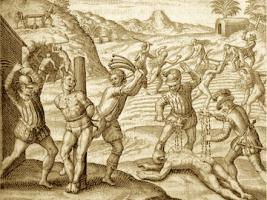
Paz’ insight into how colonial encounters in the Americas were directly tied to the violation of female bodies serves as a looking glass into later centuries, wherein women were similarly violated through enslavement, rape, and the exchange of their bodies.In the late 19th century, explorers returning from faraway lands attempted to authenticate their experiences by taking the “real native” from their habitats, bringing their captives back to the West, and putting them on display in the World’s Fairs popular during this time. From the Khoikhoi (in the West, known by the derogatory term, “Hottentots”) of Botswana who were displayed in fairs from Britain to France, to the Indigenous Americans on display at the 1893 Chicago World’s Fair, to the Apaches and Igorots of the Philippines on display at the Saint Louis World’s Fair in 1904, the black and brown body was something of a boon in the scene of freak shows that toured Europe and North America.
“Where Beard sees chaos, I see a legacy of colonial encounters and the buttressing of colonial institutions.”
The ethos of these males who peddled in the trafficking of women is astonishingly contradictory, just as the aid workers raping and exploiting women in Haiti today: on the one hand, these men set out to instill upon the native, “dark-skinned other” their supposedly progressive values, and on the other, these men set up their objects of curiosity as caged spectacles, imprisoned as a means for the white Westerner to understand their own humanity. These World’s Fair installations were part of the rise of both eugenics and social sciences in the 19th century -- specifically ethnology, where people were put on display in human zoos to show Westerners how people around the world lived in what was believed to be a “rapprochement” between West and East, even if entirely curated. The obvious problem with these zoos and expositions is that there was little consciousness at the time about how these “natives” felt about being kidnapped and enslaved.
Where these fairs concerned women, the stories were always the same: kidnapping, sexual slavery, freak shows, then death. Sarah Baartman was taken from the Gamtoos Valley in the Eastern part of the Cape Colony (present-day South Africa) and brought to England in 1810. Bought and sold from handler to handler and shown at various fairs in England and Ireland, she was exhibited as part of a freak show under the name “Hottentot Venus." Finally, in 1814, she was brought to the Palais Royal in Paris where she was enslaved and became the object of scientific study. Parallel to male colonizers sexually objectifying women during this time were French scientists who were interested in knowing the size of black women’s labia. The head of the menagerie at the Muséum national d'Histoire, Georges Cuvier, used Baartman in his new discipline, comparative anatomy, developing his theory that Baartman was the “missing link” between humans and animals, with Cuvier referring to her as an “orangutan” and a “monkey.”
“The ’Hottentot Venus’ was brought to the Palais Royal in Paris where she was enslaved and became the object of scientific study.”
Baartman died in 1815 at the age of 25. After her death, Cuvier dissected her body, displaying her remains. Her brain, genitals, skeleton, and a plaster cast of her body were on display until 1974 at the Musée de l’Homme, not repatriated to Hankey, South Africa until 2002. For all the scientific knowledge Cuvier hoped to amass by violating and dissecting Baartman’s body, what he really brought to light was the kind of “civilized” behavior Western culture interprets as “normal.” Indeed, generations of violations against dark-skinned bodies, have had the effect of normalizing rape as a necessary part of civilization.
What would lead someone like Beard to view women as necessary victims of male violence and white male “civility” as something that comes and goes like a headache? The question surrounding our humanity didn’t begin with women’s absence from the Universal Declaration of Human Rights, nor did it begin with Sarah Baartman’s labia on display for over 150 years. The answer to the question, “Are women human?” lies somewhere between these historical moments and our modern excusing of men’s abusive behavior, supposedly brought on by “disaster” and the presence of othered bodies and cultures. Women cannot possibly be viewed as human so long as our humanity is determined by men’s circumstantial “civilization.” These men are in fact the “disaster zone,” ignoring the very civilized request that they treat women and girls as human beings.
Julian Vigo is a scholar, film-maker and human rights consultant. Her latest book is Earthquake in Haiti: The Pornography of Poverty and the Politics of Development http://www.amazon.com/Earthquake-Haiti-Pornography-Politics-Development/dp/0992835402 (2015). She can be reached at: julian.vigo@gmail.com, mailto:julian.vigo@gmail.co









 The political fallout from Trump’s recklessness in West Asia continues around the globe, while some wonder how far the radioactive fallout might travel if the war on Iran were to go nuclear.
 The same caucus that celebrated the Emmett Till Antilynching Act refuses to condemn Israel's new death penalty for Palestinians.
 The UN has finally called the transatlantic slave trade the gravest crime against humanity. But the resolution is not reparatory justice, and the nations that voted no or abstained show themselves to…
 Misogynoir, a term meant to name the specific violence against poor and working-class Black women is now being used as a shield for political elites.
 The United States operates as an internal colonial system. Black communities are treated like colonized territories, and the white working class is used as a tool to enforce that control.